The contest, and everything around it. Bands from across India and abroad, playing to a crowd that knows the material and is not shy about it. The standard is high and the volume is honest. It runs late and it runs cold — I'll have you dressed for it, which most visitors are not.
A zone · Nagaland
Hornbill,
Hornbill,
after dark.
Everyone sells you the ten days at Kisama. I build the trip around the other half of the festival — six nights of music at a stadium in Kohima, in a state that takes its bands more seriously than any other in the country.


The zone holdsKohima, Kisama, Khonoma, Dzükou
The musicHornbill Music Festival — IG Stadium, Kohima. Nightly, usually about 5–10 December.
The day festivalKisama, 12 km out. 1–10 December.
So we arriveAround the 3rd, and stay to the end. The back half is the half that matters.
Nearest airportDimapur — roughly three hours by road to Kohima
Kohima sits atAbout 1,450 m. Single figures at night, and you will be out in it.
Suggested lengthNine nights. Six is possible. Four is a waste of the flights.
GroupTwo to twenty — yours, nobody else's
PermitsAn Inner Line Permit is required. I arrange it.
Who comesMe, throughout. Plus specialist for the village days.
Why I build this trip around the music.
Nagaland was effectively shut for fifty years — permits, insurgency, a long unfinished argument with Delhi. What grew inside those years, in a state that is overwhelmingly Baptist, was singing. Choirs in every village, four-part harmony as an ordinary Sunday skill, and then, when the state opened, an electric guitar scene that came out of nowhere and turned out to be the best in India.
The state noticed, and did something almost no Indian state has done: it began funding its musicians directly, as policy. The rock contest at Hornbill is among the oldest in the country and has been a serious prize for a serious band for over two decades.
So this is not a cultural display with a concert attached. It is a music festival that happens to sit inside one. Most itineraries treat the nights as an optional extra, which is roughly like going to Salzburg for the pastry.
DaysVillages, valleys, the long drives
NightsKohima. Late.
MorningsDeliberately slow
How the week is built
The clock runs backwards here, so we run with it.
Kisama and the villages happen in daylight. The stadium happens from evening until late, six nights running. Any itinerary that tries to do both at full tilt will break your group by day four — I've watched it happen to other people's.
So we plan the days around the nights. Mornings start late and stay soft. The hard driving, the walking, the valley — all of that goes early in the trip, before the music begins. Once the stadium opens, the daytime lightens deliberately: one thing, done well, and back to a warm room by five.
Two mornings at Kisama is the right dose, taken early and before the coaches arrive. Not ten. There are operators who will happily sell you ten.
What you'll actually hear
Four kinds of music, and only one of them is on the stadium bill.
The stadium
Sunday
Church, for the singing. This is the one I'd fight for. A packed Kohima church on a Sunday morning, four-part harmony from a congregation that has been doing it since childhood, no microphones needed. It is free, it is not put on for you, and more of my travellers have cried in that hour than anywhere else in the nine nights.
Li
The folk songs, sung close. Li is the Chakhesang word for the old songs — worked out in the fields, in unison, without instruments. You can hear a version of this on a stage at Kisama. You can hear the real thing in a room in a village, with eight people and no audience, which is what I try to arrange. Name who you actually arrange this with.
Off the bill
The town itself. Kohima in the first week of December is a music town in a way that doesn't need a ticket — a night bazaar with someone playing in it, acoustic sets in small rooms, and the well-known fact that the man who just served you dinner is in a band. We follow this rather than schedule it.
The daylight half
Three places within an hour of Kohima.
These carry the front of the trip, before the nights get long.
Khonoma
The village that stopped hunting. An Angami village about twenty kilometres west, terraced down a hillside in a way that will make an engineer go quiet. In the late nineties Khonoma banned hunting across its own forest and turned it into a sanctuary — for the Blyth's tragopan, among others. They did it themselves, unasked. We stay the night rather than visiting for two hours, which is the whole difference.
Kohima
The war cemetery. In 1944 one of the closest-fought battles of the Second World War was decided here, partly across the tennis court of the Deputy Commissioner's bungalow. The court is still marked out in stone on the hillside among the graves. It takes forty minutes and people are generally silent afterwards. I don't put it on a morning after a late night.
Dzükou
The valley, if your legs want it. A steep climb from Viswema or Jakhama onto a valley floor that looks like it belongs somewhere else entirely — bare, folded, green even in December. A real walk, not a stroll, and the hut at the top is basic. It goes at the start of the trip or not at all. A third of every group opts out and has a very good day in Kohima instead.
This is a sketchNot an itinerary. Yours will be different by the second conversation.
Anchored toThe music nights, which the state publishes each autumn
A shape, not a schedule
What nine nights has looked like.
Written out so you can see how I think about time, not so you can buy it. The dates below move every year with the published music programme — the shape doesn't.
Nights 1–2
Fly to Dimapur, drive up to Kohima. Nothing planned the first evening but dinner and getting used to the cold — it is colder than anyone expects. Next day, the town on foot: the cemetery, the market, a long lunch. Early nights, on purpose. You're banking sleep.
Nights 3–4
Over to Khonoma for two nights in the village — the terraces, the forest edge, the old fort site. For the walkers, Dzükou goes in here. This is the physical half of the trip and it is deliberately finished before the music starts.
Night 5
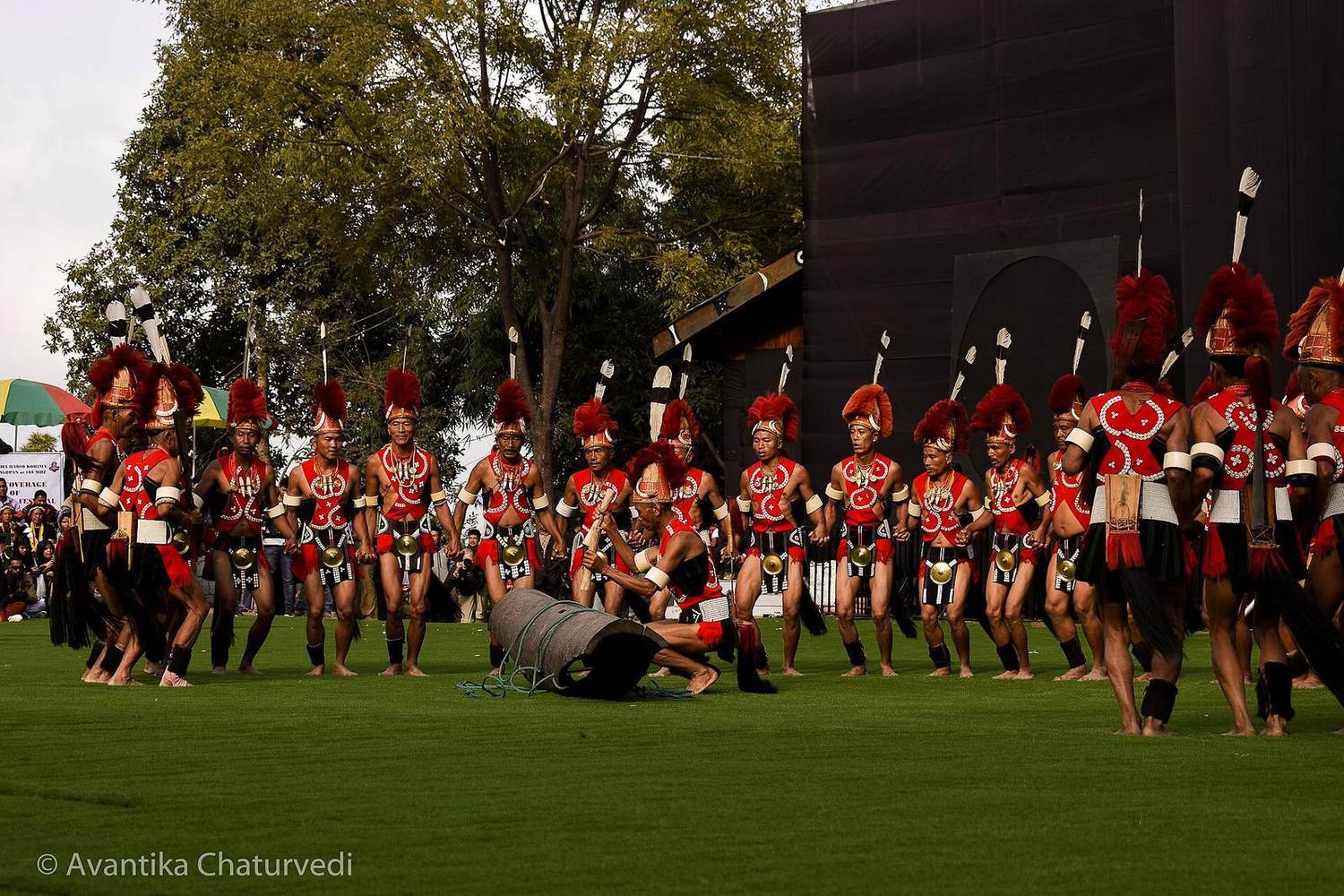
Back to Kohima. Kisama early the next morning, before the coaches — the morungs, the fires, people getting into headdresses that took a year to make. Away by one. Then the first night at the stadium.
Nights 6–8
The run of music nights. Days stay light: one thing each, a second short morning at Kisama, the night bazaar, and a Sunday morning in a church if the calendar gives us one. Late back every night, and nothing before ten the next day.
Night 9
The last night of the contest, then a slow return via Dimapur — or your choice of second district for those who want three more days. Further east is a different Nagaland again, and worth the roads if the group has the stomach.

KohimaName the property you actually use — and how far it is from the stadium at midnight
KhonomaA village homestay. Good beds, hot water, thin walls.
DzükouA shared hut, or canvas. Genuinely basic.
Where you sleep
I'll be honest about the beds, because December is the wrong time to find out.
There is no five-star hotel in Kohima and there is not going to be one. What there is: a handful of well-run places with real heating and better food than the buildings suggest, and homestays in Khonoma where the family cooks and you eat what they eat.
For this trip one thing outranks all the others — how long it takes to get from the stadium to your bed at half past midnight, in traffic, in the cold. I book for that first and the view second. Where comfort doesn't exist I'll say so in advance rather than let you discover it at nine at night at fifteen hundred metres.
Worth knowingNagaland has been officially under prohibition since 1989. Plan accordingly, and legally.
Eating, and the other thing you're wondering
A dry state with the best rock crowd in India. Both of those are true.
The prohibition is real and I won't work around it or pretend otherwise. What I will do is tell you now rather than let you find out on the first night, and make sure the food is good enough that you stop thinking about it: smoked pork with akhuni, pungent enough that you'll remember the room. Anishi, from fermented yam leaf. The king chilli, used with far more restraint than its reputation suggests.
This is not food adjusted for visitors, and some of your group won't take to it. There is always rice, always pork, always something plain. But I'd ask them to try the akhuni on the first night, while they're still brave.
Indicative₹0,00,000 per person, nine nights, party of six
IncludedList it plainly — say whether music tickets are in
Not includedList this plainly too
What it costs
I'll give you a number, and then show you how it was built.
Because nothing here is a package, the price moves with the group. Six share the vehicles and the specialist between them; two do not, so two costs more a head, and I'd rather you heard that from me than worked it out afterwards. Above about twelve we need a second vehicle and a second pair of hands, and there's a step in the cost there too.
December is the one month Kohima is full, and the music nights are the fullest part of it. Rooms are held eight or nine months out. This is the one trip where I'll push you for an answer.
Put a real indicative figure in the margin. A band — "from X per person" — is enough. Refusing to publish any number at all reads as evasive to exactly the people you want.

Plainly
Who this particular trip is not for.
- Anyone who wants to be in bed by ten. The best part of this trip happens after nine at night, six nights running.
- Anyone who wants to be warm. It is cold, you'll be standing outside in it after dark, and no amount of money fixes this.
- Anyone who needs a drink with dinner every night. The state is officially dry and I won't work around the law.
- Anyone who doesn't much like live music. Half the value of this trip is a stadium, and there's no polite way around that — let me send you to Panna or Orchha instead, and I'll mean it.
- Anyone unwilling to be on a road for three hours at a stretch. The distances are short and the roads are not.
- Anyone who can't decide by around March. The rooms will be gone.
Begin a conversation
If December in Nagaland has been sitting at the back of your mind, start here.
Tell me who's coming and roughly what you're after. I'll write back myself, and if I think somewhere else would suit you better, I'll say that instead.
Elsewhere
Other zones I keep going back to.
BundelkhandKhajuraho · Panna · Orchha
A thousand years of sandstone, one river, and two dynasties who thought they were building forever. It wants ten days.Read this one in full →
Ladakh, all of itKargil · Zanskar · Leh · Nubra · Hanle
Both districts, climbed low to high over eighteen nights. The one zone where the extra days are a safety margin, not a preference.Read this one in full →
The TharJodhpur · Khichan · Jaisalmer · Barmer
The zone that works by subtraction, timed to a new moon. Twelve nights.Read this one in full →
The VindhyasAnd whatever you bring me
No date attached to that one either.Back to the list →